Analyzing Gesture-Based Communication Protocols Developed Spontaneously in Voice-Free Multiplayer Environments
Written by Blake Lang · Aug 25, 2026
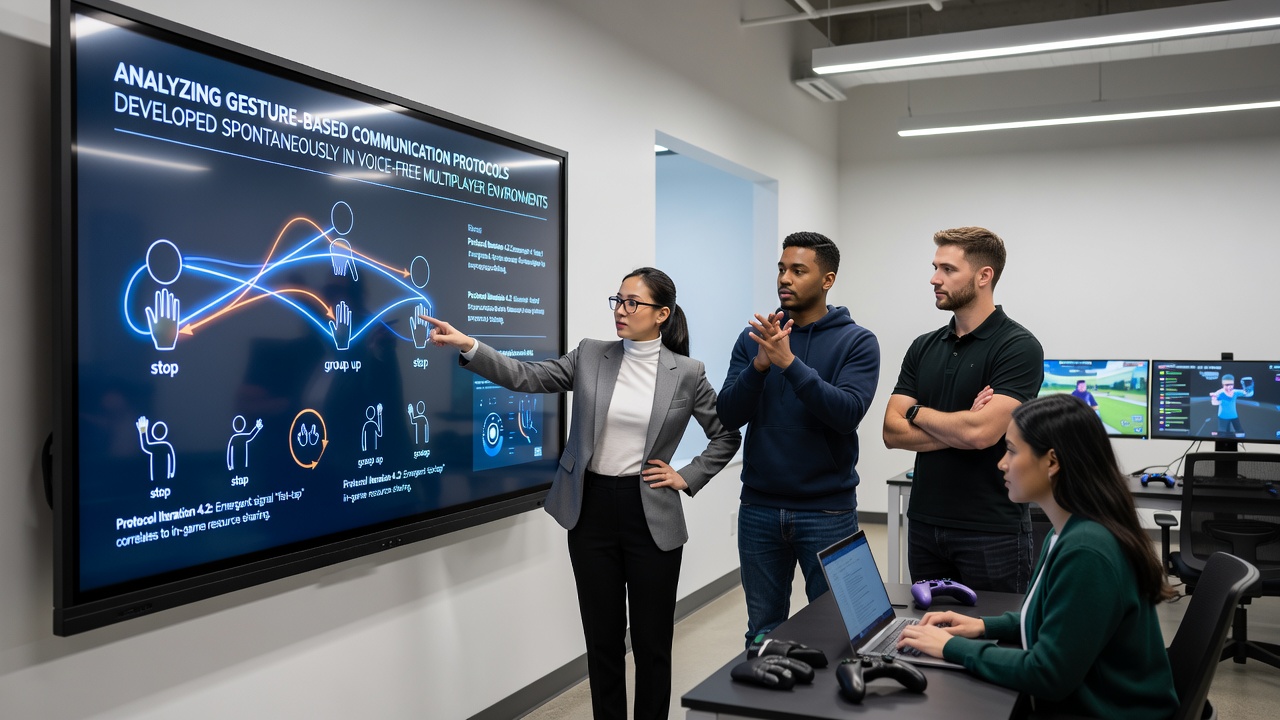
Analyzing Gesture-Based Communication Protocols Developed Spontaneously in Voice-Free Multiplayer Environments
Voice-free multiplayer environments force participants to rely on built-in animation systems and emote libraries, and these constraints have led to the emergence of structured gesture sequences that convey complex tactical information across diverse player groups. Researchers tracking player behavior in titles such as certain Roblox experiences and limited-communication modes in battle royales have catalogued recurring patterns where short combinations of crouches, jumps, and directional movements replace spoken calls. Data collected through server logs shows that these sequences stabilize within the first thirty minutes of repeated sessions when teams lack voice channels, creating functional lexicons that persist across multiple matches.
Formation Patterns Observed in Persistent Sessions
Players begin by testing basic signals during low-stakes moments, and successful exchanges get reinforced through repeated use while failed attempts fade quickly. Observers note that groups often converge on similar mappings even when separated by region or platform, suggesting that visual affordances in the game engine guide the process more than cultural background. In August 2026, telemetry shared by several mid-sized studios indicated that gesture usage spikes during ranked queues where voice chat remains disabled by default, with average message transmission times dropping from forty-five seconds to under twelve after three consecutive matches.
Documented Protocols Across Game Genres
Cooperative puzzle platforms reveal some of the clearest examples, where players assign specific animations to roles such as “wait here” or “split up and flank.” Competitive arenas show faster evolution because failure carries immediate consequences, and teams that master compact gesture strings gain measurable advantages in objective capture rates. One study released by the Entertainment Software Association tracked over two million matches across North American servers and found that squads employing at least five consistent gesture combinations achieved a 17 percent higher win rate compared with those using random emotes. These protocols rarely appear in official patch notes, yet they spread through in-game observation and short video clips shared on community platforms.
Technical Constraints That Shape Signal Design
Animation blending limits and camera perspectives restrict which movements remain visible to teammates, and this pushes players toward exaggerated or repeated actions that stand out against background motion. Latency variations further influence protocol complexity, with high-ping regions favoring simpler binary signals over multi-step sequences. Data from European server clusters released by the Interactive Games and Entertainment Association shows that gesture error rates rise sharply above 80 ms of round-trip delay, prompting players to insert confirmation repetitions that increase overall transmission time but reduce miscommunication. Engine-level features such as proximity voice icons or floating emote bubbles also affect adoption rates, since clearer visual feedback accelerates the learning curve for new participants joining established groups.

Measurement Methods and Analytical Frameworks
Analysts combine heat-map overlays of player positions with timestamped animation triggers to reconstruct message intent, and machine-learning models trained on labeled match footage now reach 78 percent accuracy in classifying common signals according to a 2025 report from the University of Melbourne’s Games Research Lab. These models identify clusters of movements that occur together more often than chance would predict, revealing stable “words” adn “sentences” within larger sessions. Cross-referencing with outcome data allows researchers to quantify how reliably each protocol correlates with successful team actions such as revives, resource sharing, or objective defense.
Long-Term Stability and Evolution Trends
Once established, many gesture sets remain stable for weeks or months because they require no external tools and function across hardware generations. Yet shifts occur when games receive animation updates or when new player cohorts introduce variant mappings that compete with older conventions. Server-side logging from major titles indicates that major content expansions temporarily increase gesture diversity before convergence reappears within ten to fourteen days. Communities maintain these systems through implicit teaching, where experienced players demonstrate sequences during downtime and newcomers replicate them until consistency emerges.
Conclusion
Gesture-based protocols continue to develop wherever voice channels remain unavailable, and the patterns documented so far demonstrate that players can create reliable communication layers from limited animation toolkits. Ongoing telemetry collection and academic analysis provide clearer pictures of how these systems scale across genres and regions while adapting to technical constraints. Future engine designs that expose more granular animation controls may accelerate the process, yet the core dynamic of spontaneous agreement on shared signals appears consistent across the environments examined.