Evolution of Save System Designs and Their Influence on Player Risk Assessment in Adventure Titles
Written by Dana Jenkins · Jul 26, 2026
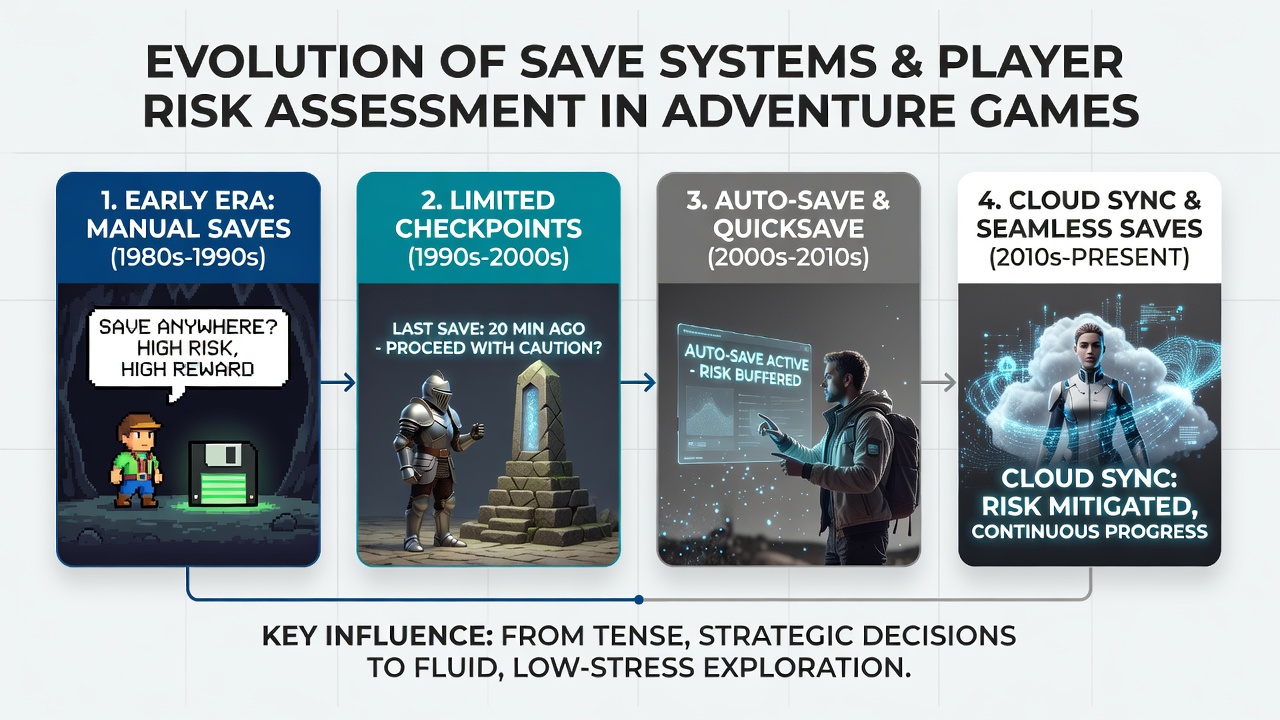
Evolution of Save System Designs and Their Influence on Player Risk Assessment in Adventure Titles
Adventure titles have shifted their save mechanisms across decades, moving from rigid manual entries with limited slots toward seamless cloud integration and adaptive checkpoints that reshape how players evaluate danger during exploration and decision-making sequences. Early designs often restricted saves to specific locations or required manual activation at fixed intervals, forcing participants to weigh each action against the possibility of losing substantial progress when errors occurred.
Early Save Mechanics in Foundational Adventure Games
Text-based adventures from the 1970s and 1980s relied on command-line save commands that stored progress in external files, yet these systems frequently capped the number of available slots and demanded precise typing to avoid data loss. Players therefore approached puzzles and combat encounters with heightened caution, since restarting from distant points consumed significant time and discouraged experimental approaches to problem-solving. Studies from university archives show that limited save access correlated with lower rates of repeated attempts at high-stakes sequences, as participants conserved resources for guaranteed successes rather than testing alternative paths.
Transition to Multiple Slots and Manual Flexibility
By the 1990s graphical adventures introduced multiple save slots that allowed branching experimentation while still requiring deliberate player intervention to preserve state. This change expanded risk tolerance in some cases because individuals could maintain separate files for different strategies, yet it also introduced management overhead that occasionally led to overwritten data when users neglected to label entries clearly. Industry figures reveal that titles incorporating slot-based systems saw measurable increases in completion rates for optional content, since explorers could backtrack without total loss yet still faced consequences if they failed to save before critical narrative branches.
Checkpoint Systems and Their Emergence in the 2000s
Checkpoint mechanics gained prominence during the 2000s as hardware capabilities expanded, placing automatic restore points at regular intervals or after key events without requiring user input. These designs reduced frustration from repeated failures while simultaneously altering risk calculation patterns, because players encountered fewer penalties for aggressive movement through hazardous environments. Research conducted across European game design programs indicates that checkpoint frequency directly influenced willingness to engage with environmental hazards, with denser placement correlating to higher exploration metrics in open areas.
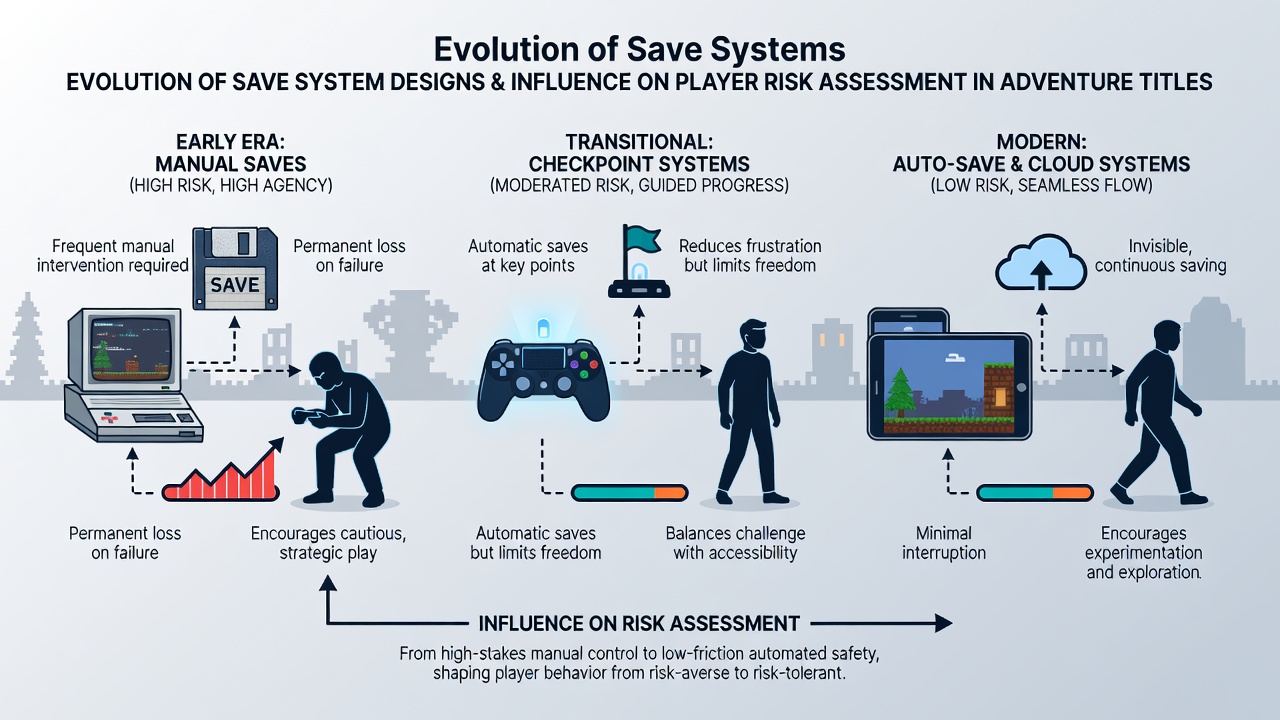
Designers began spacing checkpoints strategically to maintain tension, placing them before boss encounters or complex puzzles while omitting them during traversal segments that rewarded careful observation. Data collected by the Entertainment Software Association demonstrates steady growth in average session lengths alongside these implementations, suggesting that reduced save friction encouraged sustained engagement rather than frequent reloads from earlier points.
Cloud Saves, Autosaves, and Contemporary Adaptations
Cloud-based saving and continuous autosave routines became standard by the mid-2010s, synchronizing progress across devices and eliminating most manual triggers. Adventure games adopted these features to support longer narrative arcs, yet observers note that constant background saving can diminish the perceived weight of individual choices when failure states resolve instantly. As of July 2026 recent platform updates have further refined these systems with optional permadeath modes that restore manual restrictions for players seeking heightened stakes, creating segmented communities with distinct risk profiles.
Adaptive algorithms now adjust save density based on detected player performance patterns, increasing checkpoint frequency after repeated deaths while tightening intervals during stable segments. Academic analyses from Canadian research institutions link these dynamic adjustments to shifts in behavioral data, where participants demonstrate greater willingness to attempt high-difficulty routes once the system signals supportive save placement through subtle interface cues.
Measuring Influence on Risk Assessment Behaviors
Player risk assessment manifests through observable patterns such as time spent scouting ahead, frequency of inventory optimization before progression, and willingness to engage unknown entities. Limited save designs historically amplified these preparatory actions, whereas frequent autosaves correlate with more direct forward momentum according to aggregated telemetry from major publishers. Titles that blend both approaches, offering manual overrides alongside automatic backups, allow individuals to calibrate their own caution levels depending on current session goals.
Examples from long-running series illustrate this progression clearly, where early entries demanded precise save timing before major decisions while later installments incorporate seamless restoration that lets players test dialogue outcomes or combat tactics without permanent setbacks. Those patterns appear consistently across regions, with developers in Asia and North America converging on hybrid models that preserve narrative tension without punishing experimentation outright.
Conclusion
Save system evolution continues to intersect with player psychology through deliberate design choices that balance accessibility against meaningful consequence. Data from ongoing industry reports and cross-regional studies confirm that each iteration alters how participants gauge potential losses against possible rewards, shaping both short-term decisions and long-term engagement strategies within adventure titles. Future refinements will likely incorporate machine learning to predict individual risk preferences, further personalizing the experience while maintaining core structural integrity across diverse player bases.