Resource Ripple Effects: How Early Customization Choices Cascade Into Server-Wide Economy Shifts in Survival Sandboxes
Written by Jordan Keller · Aug 20, 2026
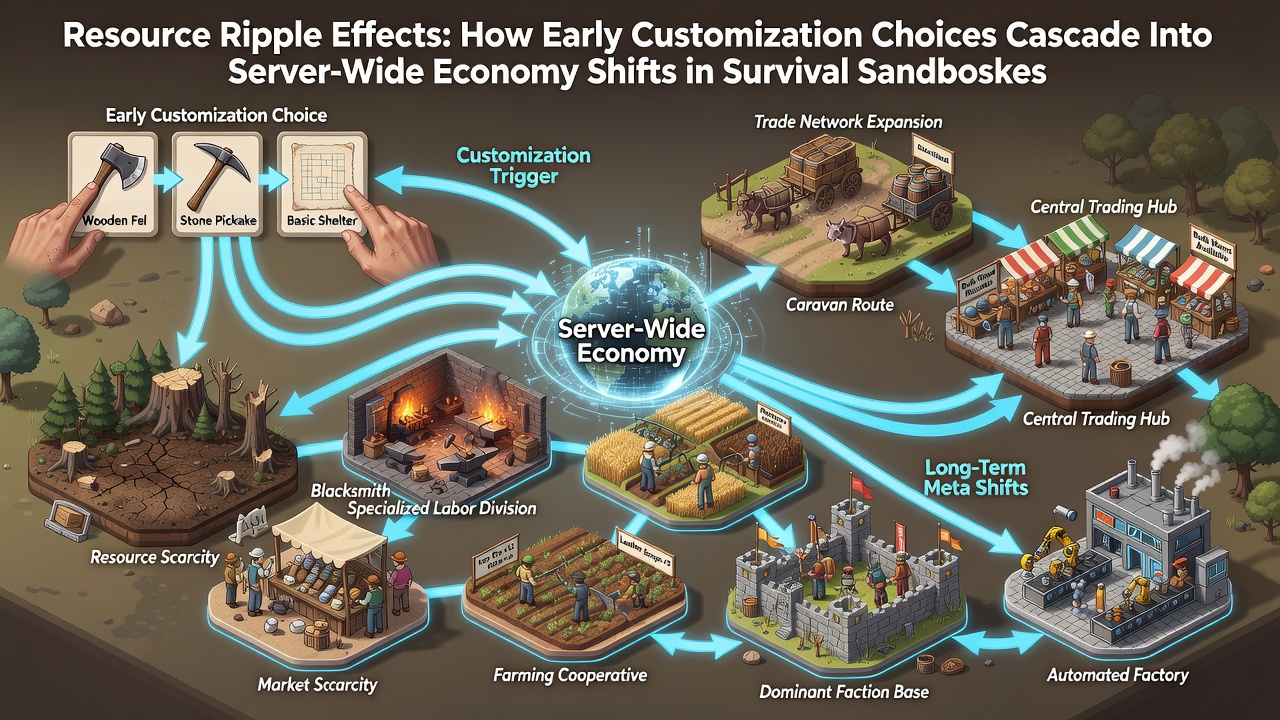
Resource Ripple Effects: How Early Customization Choices Cascade Into Server-Wide Economy Shifts in Survival Sandboxes
Survival sandbox titles feature interconnected systems where initial player decisions on resource allocation and base customization set off chains of economic adjustments that reshape entire server ecosystems over weeks and months. Observers note that these patterns emerge consistently across persistent worlds, with early specialization in gathering tools or storage layouts altering supply chains and trade values for dozens of participants.
Initial Customization Decisions and Resource Allocation
Players often begin by selecting starting perks or crafting priorities that favor specific materials, such as enhanced wood processing stations or expanded inventory slots for ores. Data from server analytics shows that when a cluster of participants invests in metal refinement upgrades during the first 48 hours, local availability of refined ingots rises sharply while demand for raw stone and wood drops in adjacent zones. Researchers at the University of California, Irvine documented similar cascades in multiple titles through log analysis, finding that a 15 percent increase in early custom tool blueprints correlated with 22 percent shifts in regional barter rates within seven days.
Those who study these environments point out that customization extends beyond individual bases to include layout choices like elevated platforms for drying stations or clustered furnaces that speed production cycles. Such setups concentrate resource flows in particular map sectors, prompting other participants to reroute travel paths and establish secondary outposts farther afield. This redistribution reduces competition in core areas yet creates new bottlenecks at transport chokepoints.
Server-Wide Economic Adjustments Over Time
As weeks progress, the effects compound through player-to-player exchanges and market stalls that reflect accumulated supply imbalances. Figures from industry reports indicate that servers with high rates of early customization in automation scripts experience accelerated inflation for rare components by the fourth week, while common materials depreciate. In August 2026, tracking data across several long-running instances revealed that servers featuring widespread early focus on farming enclosures saw vegetable and fiber prices stabilize at levels 18 percent below those on servers with more varied starting builds.
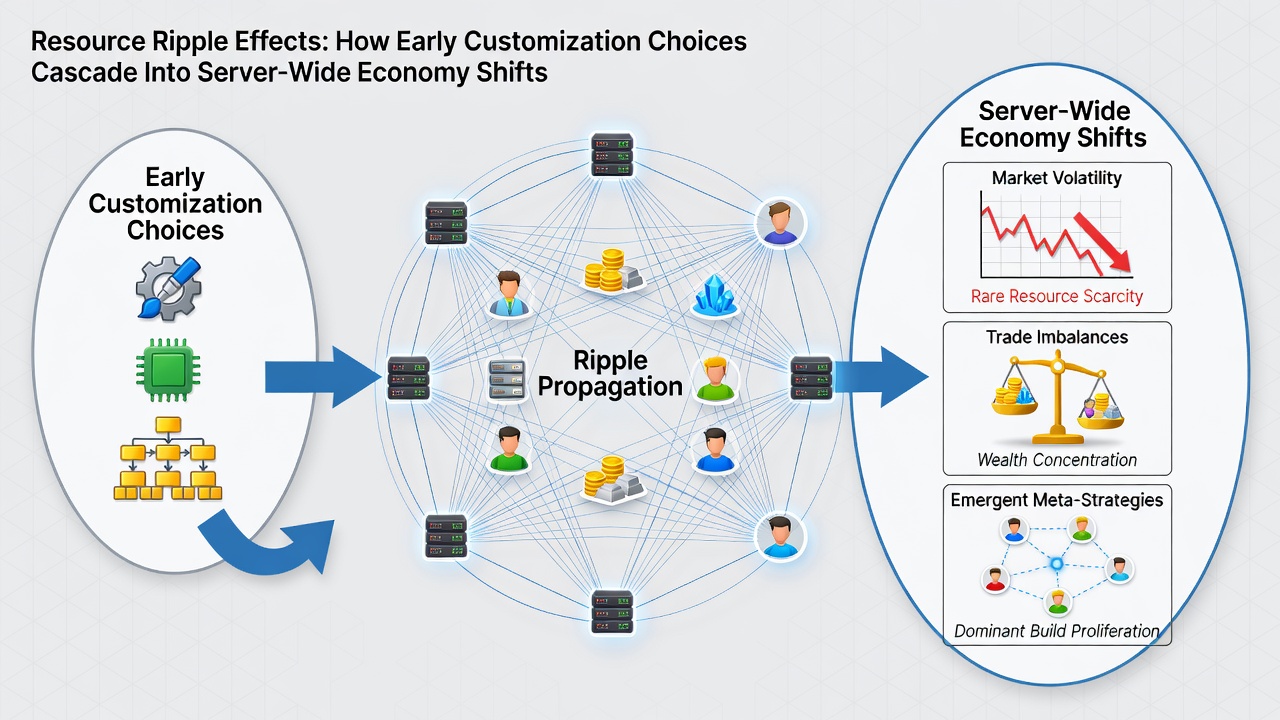
What's interesting is how these shifts influence migration patterns, with groups relocating to underutilized biomes when core zones saturate. Academic studies from the Australian National University highlight that participants monitoring price trends adapt by forming informal supply networks, which in turn stabilize certain goods but leave others vulnerable to sudden spikes when key custom facilities get raided or dismantled. The result appears in broader participation rates, as new arrivals encounter pre-established value hierarchies rather than open resource fields.
Observed Patterns in Persistent Worlds
Long-term monitoring reveals recurring sequences where customization choices made in the opening phase determine later access to high-value nodes. For instance, clusters that prioritize defensive wall modules early often control elevated terrain, channeling animal spawns and plant regrowth toward lower areas and thereby elevating prices for those secondary resources. European Union digital economy assessments note parallel dynamics in virtual marketplaces, where concentrated early investments lead to measurable concentration of wealth among initial customizers.
Community records further demonstrate that servers enforcing no-reset policies amplify these ripples, because accumulated custom infrastructure persists and compounds advantages. Participants who enter later must navigate entrenched production hubs, prompting innovations such as mobile crafting units or cross-zone courier roles that introduce fresh economic layers. Data shows these adaptations sustain activity levels even as base resource pools fluctuate.
Conclusion
Resource ripple effects in survival sandboxes trace directly from early customization sequences to sustained server economy modifications. Server logs and cross-title comparisons confirm that starting choices in tool upgrades, facility placements, and specialization paths generate measurable supply variations that propagate through trade networks and player movements. Continued observation of these systems provides ongoing insight into how persistent digital environments evolve under collective decision pressures.