Tracing the Development of Adaptive Difficulty Algorithms Across Generations of Action Platformers
Written by Frankie Fischer · Jun 11, 2026
Tracing the Development of Adaptive Difficulty Algorithms Across Generations of Action Platformers
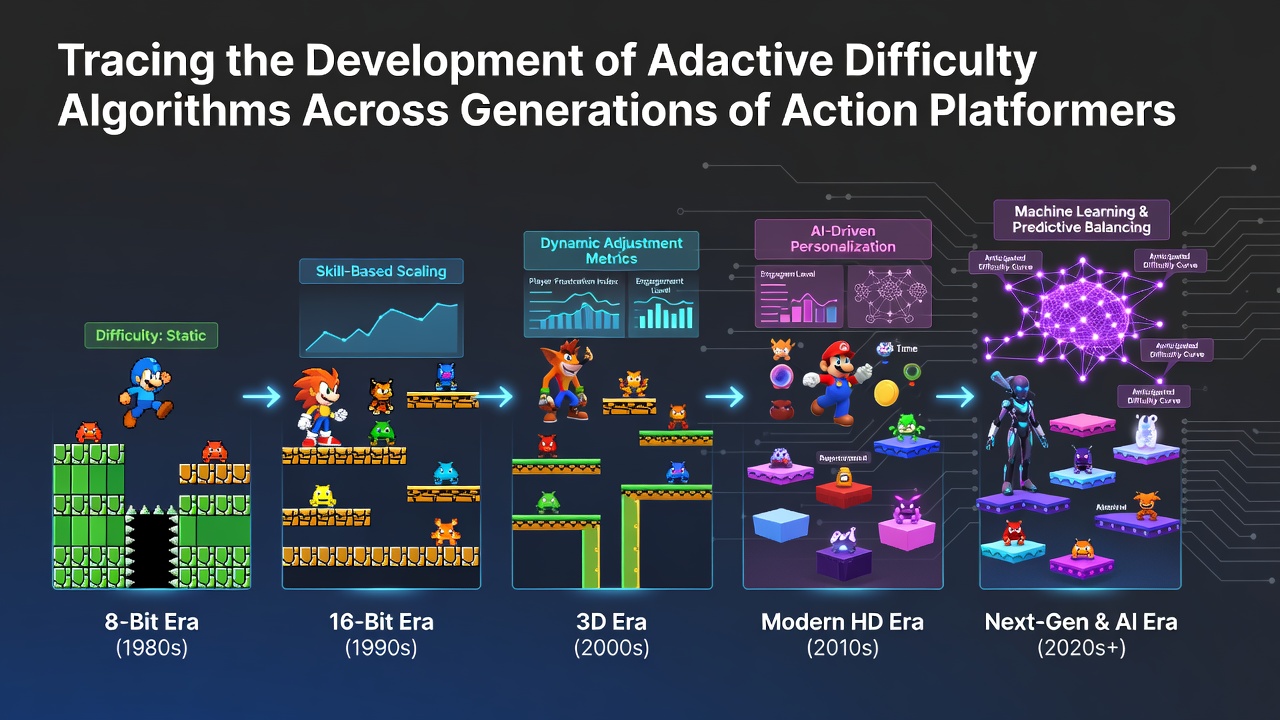
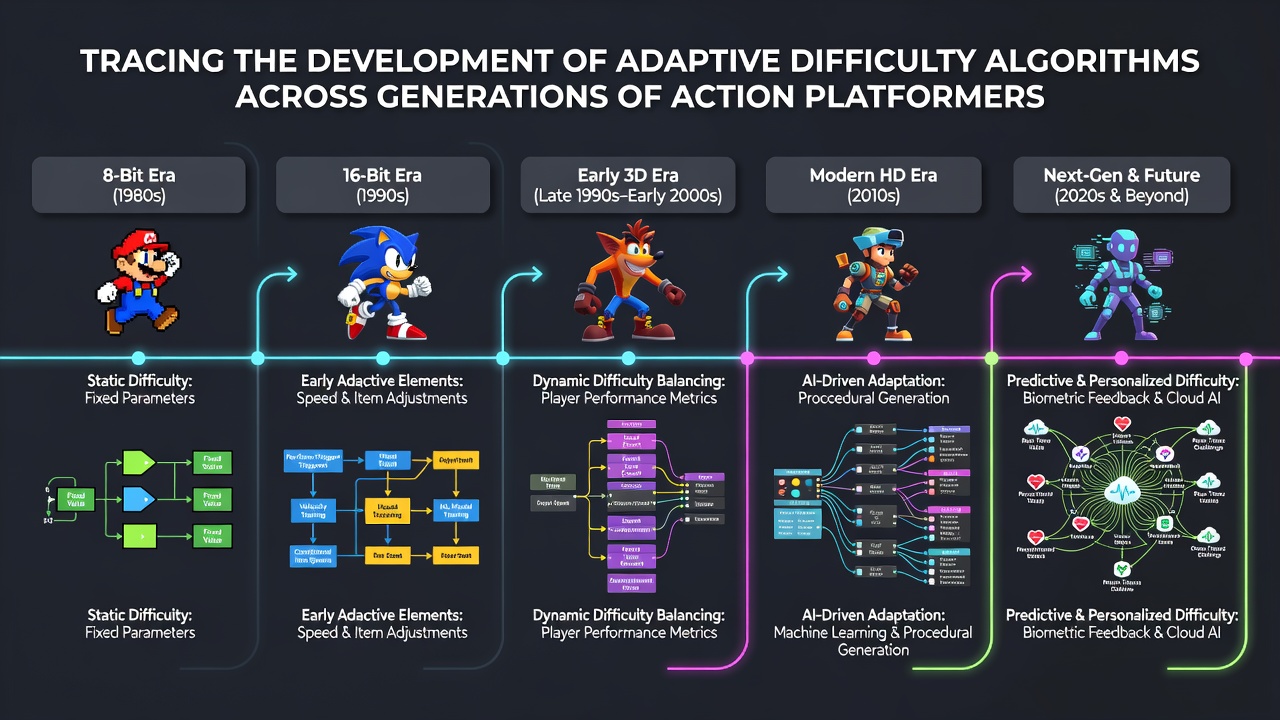
Action platformers have relied on difficulty systems that respond to player input since the earliest arcade cabinets, and developers refined these mechanisms across hardware generations to maintain engagement without manual intervention. Early titles such as those released in the 1980s used preset enemy placements and movement speeds that remained constant regardless of performance, yet designers introduced basic adjustments through hidden variables that altered spawn rates when certain score thresholds were crossed. These rudimentary approaches laid the groundwork for later algorithms that tracked metrics like death frequency and completion times to modify level layouts on subsequent attempts.
Foundations in 8-Bit and 16-Bit Eras
During the 8-bit period console manufacturers limited processing power restricted real-time calculations, so programmers embedded simple counters that incremented when players failed specific segments and then reduced enemy aggression or extended jump windows on reload. Titles from that era demonstrate how limited memory still allowed for conditional branches that responded to accumulated player data stored in RAM. By the 16-bit generation hardware improvements enabled more granular tracking, and studios implemented systems that measured consecutive successful inputs to gradually increase enemy projectile speeds while preserving core level geometry.
Researchers at institutions across North America documented these early techniques through disassembly of commercial cartridges, revealing that adjustments often occurred at checkpoint reloads rather than during active play. Data collected from preserved prototypes shows that developers tested multiple scaling curves to prevent players from progressing too quickly through challenging sequences. Those who studied the codebases note that the algorithms prioritized fairness over strict progression, adjusting variables such as gravity multipliers and health recovery rates based on session length.
Transition to 3D and Early Dynamic Systems
The shift to 3D platformers in the late 1990s introduced camera complexity alongside movement mechanics, prompting teams to expand adaptive frameworks to account for spatial navigation errors. Algorithms began logging positional data at regular intervals and applied modifiers that altered enemy patrol routes when repeated failures occurred within defined zones. Industry reports from European game development associations indicate that these changes helped stabilize retention metrics during playtesting phases conducted in controlled environments.
One notable implementation appeared in titles that monitored overall play duration and introduced temporary assistance features such as highlighted ledges or reduced fall damage after extended periods without progress. Observers note that these features activated through threshold-based triggers rather than continuous monitoring to avoid disrupting skilled players. Academic examinations of source materials from that period show developers balanced computational cost against responsiveness, often limiting checks to once per stage rather than every frame.
Contemporary Implementations and Machine Learning Integration
Modern action platformers leverage increased processing capabilities to run more sophisticated models that analyze input patterns across entire sessions. Systems now employ statistical models that compare current performance against aggregated data from previous players, then apply targeted changes such as enemy density reductions or checkpoint repositioning. Studies published through Australian research networks demonstrate that these approaches correlate with improved completion rates across diverse skill levels when tested on large participant groups.
By June 2026 several studios have incorporated lightweight machine learning components that refine difficulty curves during live updates based on anonymized telemetry streams. These updates occur through server-side processing that feeds back into client-side parameters without requiring full game restarts. Figures released by international trade organizations reveal consistent adoption rates among independent developers who previously lacked resources for custom AI solutions. Engineers achieve this by training models on anonymized datasets that capture common failure points across thousands of playthroughs, allowing precise interventions at specific coordinates within levels.
Developers also integrate fallback mechanisms that revert adjustments when players demonstrate consistent improvement, ensuring that the system does not overcompensate during extended sessions. Code repositories analyzed by academic groups highlight modular designs that separate core gameplay logic from difficulty layers, which simplifies testing and iteration across multiple hardware targets. Those who examine publicly available postmortems observe that successful implementations maintain transparency logs visible only in debug modes to assist quality assurance teams.
Cross-Generational Patterns and Data Utilization
Across generations the core principle remains consistent: collect performance indicators, evaluate against predefined success criteria, and apply bounded modifications that preserve the original design intent. Early counters evolved into multidimensional vectors that incorporate variables such as reaction time, path efficiency, and resource management. Research conducted at Canadian universities confirms that vector-based approaches outperform single-metric systems when evaluated against player retention across extended campaigns.
Telemetry pipelines now transmit summarized statistics to central servers where aggregated trends inform future patches, yet individual sessions retain local processing to minimize latency. This hybrid model appears in several high-profile releases from 2024 onward and continues to expand as hardware standards improve. External analyses from regulatory bodies in the European Union have examined data handling practices within these systems to ensure compliance with privacy standards while supporting ongoing refinement of difficulty algorithms.
Conclusion
Adaptive difficulty algorithms in action platformers progressed from static counters embedded in 8-bit cartridges to distributed systems that combine local evaluation with cloud-assisted model updates. Each hardware generation expanded the scope of tracked metrics and the precision of applied changes, resulting in frameworks that respond to individual sessions while drawing on broader population data. Continued integration of refined statistical methods suggests further evolution remains possible as processing resources increase and telemetry practices standardize across platforms.